
America's Debt Spiral
Countdown to Crisis

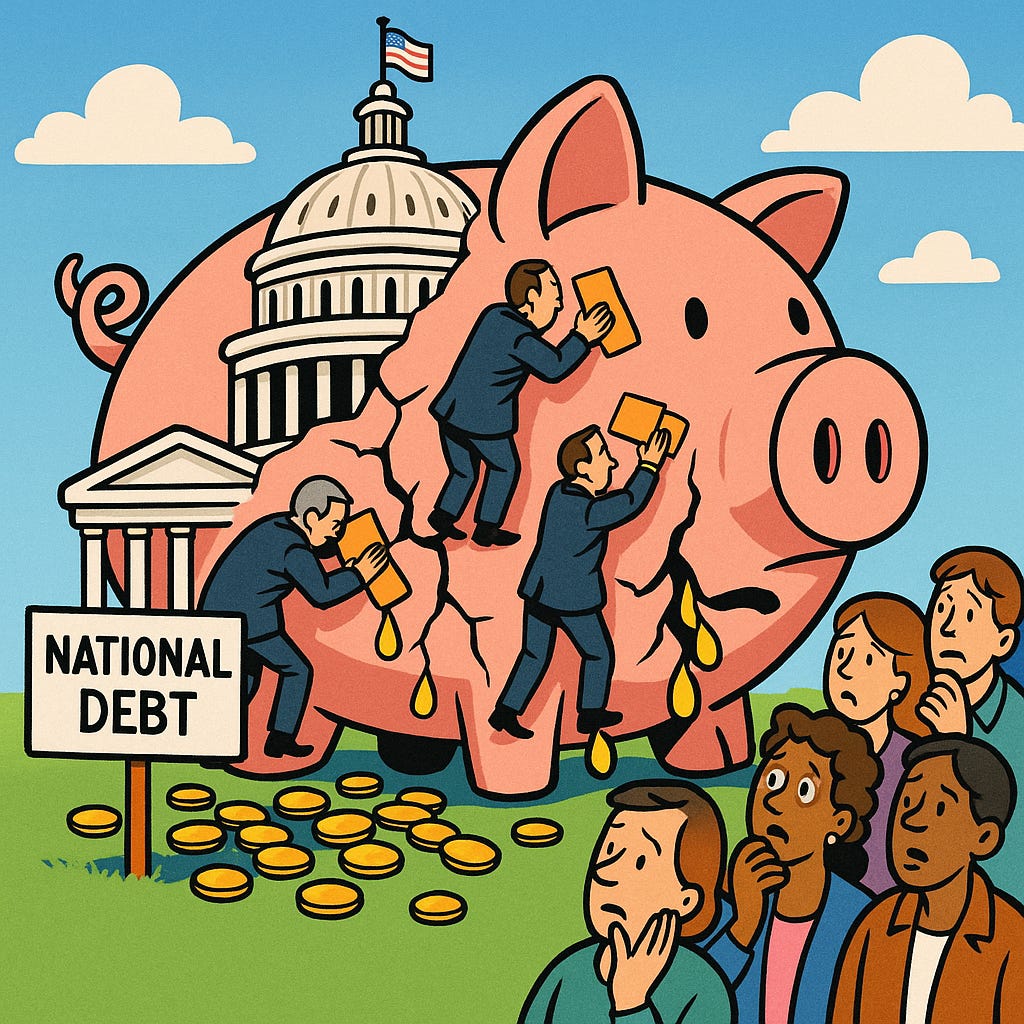
One million seconds ago was 11 days ago. One billion seconds ago was 1994 (31 years ago). But one trillion seconds ago? That was 30,000 BC, or about 24,000 years before civilizations began to form.
Understanding the sheer scale of a trillion is crucial when considering the United States national debt of $36 trillion. Given U.S. GDP of $29 trillion, America’s debt is unpayable in real, inflation-adjusted terms. On our current trajectory, we are likely to experience a big debt crisis within the next 5-7 years. Debt crises come with severe economic pain, but also complete paradigm shifts which provide opportunities for those who have studied how the debt cycle has played out over hundreds of cycles.
How did we get here?
To understand our current debt situation, we must venture back to 1945 when the current big debt cycle started. After World War II, the United States emerged as the last major industrial power. The dollar, convertible to gold, became the backbone of the new world monetary order. Under the Bretton Woods and Marshall Plan agreements, the U.S. would buy foreign goods, sending dollars abroad. Other nations accumulated U.S. dollars as reserves, effectively financing America’s spending habits and deficits.
The system worked for decades, fueling global recovery and growth. However, the privilege of printing the world’s reserve currency led to the U.S. overspending on social programs and the Vietnam War. Recognizing rising American debt levels, foreign countries lost confidence in the dollar’s value and began redeeming their dollars for gold. The only problem – by 1971, US gold reserves had dwindled to only 4% of outstanding dollar-based liabilities. Fearing the loss of all U.S. gold, President Nixon ended the dollar’s convertibility to gold, defaulting on American debt and shifting the world to a fiat monetary system.
Without gold anchoring the speedboat that is the Federal Reserve’s money printer, money supply grew dramatically, increasing 90% in the 1970s alone. Subsequently, public debt grew 750% between 1980 and 2005. This kind of credit expansion can only lead to one thing – economic bubbles – and it did. The dot com crisis of 2000-2001 and the housing crisis of 2007-2009 were both direct results of credit expansion and easy money policies, enabled by the Federal Reserve and U.S. government. Instead of letting insolvent companies and banks collapse during these crisis, which would have caused politically unfavorable short-term pain, the government instead intervened with bailouts, stimulus spending, and central bank asset purchases of toxic assets. In doing so, private sector losses were shifted onto the government balance sheet, shielding failing institutions from the consequences of their risk-taking and increasing the national debt. In other words, the central bank socialized the losses, making private company errors the problem of everyday taxpayers.
Where are we today?
And now here we are, with a debt to GDP ratio slowly but surely inching towards 130%, a number that is important for a jolting reason. Out of 51 cases of government debt breaking above 130% of GDP since 1800, 50 governments have defaulted, either nominally or in real terms – when bondholders failed to be paid back by a wide margin on an inflation-adjusted basis.
The United States currently needs to roll over approximately $9 trillion of debt annually, in addition to financing new deficits running at roughly 7% of GDP – an absurdly high number in a time of peace.
Where are we going?
Like an extravagant spender trying to solve his credit card debt problems by taking on even more credit card debt, the US is on a path towards a dangerous feedback loop where debt can spiral out of control. And this time, because so much of the debt is federal and not private, the government and Fed cannot act as a backstop.
The spiral accelerates when bond investors sell US bonds due to increased risk perception. This drives bond prices down and interest rates up, further raising borrowing costs and necessitating even more debt issuance. At a certain point, due to the sheer amount of debt and risk in the system, investors will no longer want to own American bonds.
Net selling of government debt is a major red flag, as it leads to a tightening of money and credit, which leads to 1. a weakening economy, 2. downward pressure on the currency, and 3. declining central bank reserves. These debt spirals feed on themselves and accelerate because holders of debt assets see that one way or another – through default or devaluation of their money – they will lose purchasing power.
Because this tightening process is extremely painful, the central bank does what it does best – it prints money – buying government debt and devaluing the money. While printing money makes debt payments more serviceable, it also causes serious inflation and distrust in the system, pushing people and institutions towards sound money alternatives like gold.
Having caused problems every step of the way, governments are often forced in this stage to take measures to rebuild credibility. One way to do that is to link the currency to something hard like gold or Bitcoin, neither of which can be created arbitrarily, adding confidence back into the system. With money once against backed by a hard asset, the big debt cycle can start anew, reentering the growth and prosperity stage of a new monetary order.
Return to Hard Money
While this return to hard money may or may not involve linking dollars to Bitcoin, the idea that it may happen is not as far-fetched as it was just a few years ago. For one, the Trump administration recently announced the creation of a strategic Bitcoin reserve, with the Secretaries of Commerce and Treasury directed to acquire more Bitcoin in budget-neutral ways. This move suggests at least some level of government recognition of Bitcoin’s strategic importance.
Tangentially, recall that “the ability to print money and have it accepted by the world, which is an ability that only a major world reserve currency country (especially the United States) has, is the most valuable economic power a country can have…the US is now very powerful because it can print the world’s money and would be very vulnerable if it lost its reserve currency status.” (Dalio, The Changing World Order)
Thus, if the US faces a big debt crisis, which would come along with serious challenges to the dollar’s reserve currency status, finding a new foundation for monetary credibility could be imperative. If linking the dollar to a hard asset, Bitcoin makes more sense than gold for a number of reasons:
1. Bitcoin is designed for the digital age and can be integrated seamlessly with modern financial technologies, while gold is static.
2. Being purely digital, Bitcoin allows for global transfers with final settlement in 30 minutes. Gold is costly and slow to move, requiring trusted 3rd parties.
3. Bitcoin’s supply cap is fixed at 21 million, while gold’s new supply depends on mining capacity.
A major debt crisis doesn't just trigger a recession – it marks the end of one monetary era and the beginning of another. When debt burdens become unsustainable, the system must reset: debt gets restructured or inflated away, and the rules of the game change, often wiping out those relying on yesterday's playbook.
Operating independently of central banks, Bitcoin could play a pivotal role in the paradigm shift. If the US government resorts to currency devaluation to manage unsustainable debt, Bitcoin’s fixed supply of 21 million coins provides a lifeboat on a sinking ship. As Ray Dalio, world-renowned expert on debt crises, deduced: “Perhaps this time, digital currencies like Bitcoin will benefit.” (Dalio, How Countries Go Broke) In every crisis, those who recognize the shift early can not only protect themselves, but also seize opportunities as the new order emerges.
This publication is for informational and educational purposes only — not investment, legal, tax, or accounting advice. Nothing herein constitutes a solicitation, recommendation, or offer to buy or sell any security or strategy. The author may hold — and may buy or sell without notice — securities, derivatives, or other instruments referenced. All opinions are the author’s, expressed in good faith as of publication, and subject to change without notice. Information is believed accurate but provided “as is,” without representations or warranties; errors or omissions may occur. Any forward-looking statements involve risks and uncertainties that may cause actual results to differ materially. Past performance is not indicative of future results. Do your own research and consult a qualified, licensed adviser who understands your circumstances before acting on this content. To the fullest extent permitted by law, the author and publication disclaim liability for any loss arising from reliance on this material.